
CONDITIONS TREATEDAcupuncture for Asthma
ALSO TREATED:
Headaches & Migraine · Skin Conditions · Burnout & Fatigue · Anxiety · Pain & Injuries · Back Pain · Hay Fever
Acupuncture for Asthma
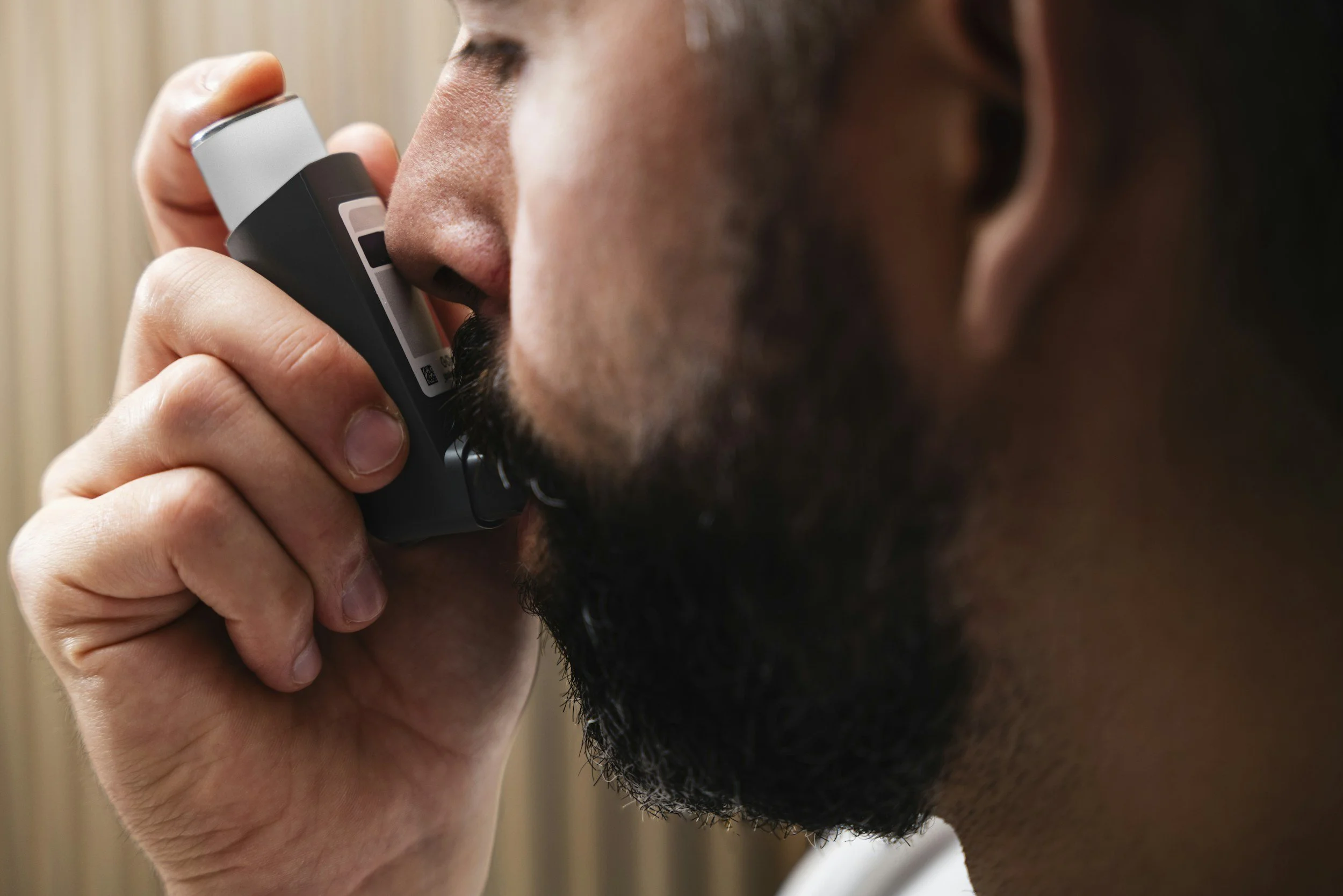
Asthma is a chronic condition, and it is treated as one. Acupuncture does not replace inhalers or prescribed medication, particularly during acute episodes, which require fast-acting bronchodilation that acupuncture cannot provide. What it can do is reduce the frequency and intensity of episodes, support lung resilience over time, and address the inflammatory and nervous system patterns that make the airways reactive in the first place.
Asthma is approached as a systemic condition with respiratory expression, not simply a breathing problem localised to the lungs.
How acupuncture helps with asthma
Asthma is defined medically by two overlapping processes: chronic airway inflammation and bronchial hyperreactivity. The airway lining is persistently inflamed, even between episodes, and the smooth muscle surrounding the bronchi responds to triggers with disproportionate and sometimes dangerous constriction. Triggers vary between individuals but commonly include cold air, airborne allergens, respiratory infections, exercise, and psychological stress. The stress component is particularly significant: the autonomic nervous system directly regulates airway tone, and a chronically sympathetically dominant nervous system lowers the threshold at which the airways react.
Acupuncture works by modulating the immune and inflammatory response, reducing baseline bronchial sensitivity, and regulating autonomic nervous system tone. Improving vagal activity — the parasympathetic counterbalance to the stress response — has a measurable effect on airway calibre and reactivity. This is part of why acupuncture tends to produce benefit not only in respiratory function but in the anxiety, sleep disruption, and stress load that so often accompany and amplify asthma.
In TCM, asthma is understood primarily as a Lung deficiency pattern, frequently with Kidney involvement. The Lung governs respiration and the descending movement of Qi through the body. When Lung Qi is deficient, the breath becomes shallow, the airways more vulnerable to external pathogenic factors, and the defensive Wei Qi — which lines the respiratory tract and forms the first layer of immune response — is weakened. This is why asthmatic patients so often catch respiratory infections easily and take longer to recover from them.
The Kidney plays a specific role in breathing that has no direct equivalent in biomedical physiology but maps closely onto clinical observation. In classical theory, the Kidney receives and roots the breath sent downward by the Lung. Where Kidney function is insufficient, the breath cannot be fully drawn in or anchored, producing the characteristic difficulty with inhalation, the sense of breathlessness that is not fully explained by airway obstruction alone, and the anxiety that frequently accompanies it. Kidney-Lung axis treatment addresses this pattern directly.
The Spleen is the third organ system consistently involved. In TCM, Phlegm is not simply mucus but a broader category of pathological fluid that accumulates when the Spleen's transformative function is impaired. Phlegm lodges in the Lung, obstructing the airways and providing the substrate for the characteristic wheezing and productive cough of asthma. Treating the Spleen to reduce Phlegm production, alongside strengthening the Lung and Kidney, forms the basis of a constitutional approach to the condition rather than a symptomatic one.
Stress and emotional load are consistently relevant and are factored into every treatment plan. Anxiety and chronic tension alter breathing mechanics directly, reinforce the autonomic dysregulation that drives hyperreactivity, and create a cycle in which breathlessness provokes anxiety and anxiety provokes breathlessness. Breaking that cycle is as much a part of asthma treatment as addressing the airways themselves.
Balance Method acupuncture for asthma
In Balance Method acupuncture, respiratory complaints are approached through the channel systems that govern the chest and airways. The main meridians of the chest are the Kidney (Shaoyin), Spleen (Taiyin), and Stomach (Yangming). The tendinomuscular meridians that influence chest movement and breathing include the Lung (Taiyin), Heart (Shaoyin), and Stomach (Yangming), with the Gallbladder (Shaoyang) influencing the sides and the Bladder (Taiyang) influencing the back.
Treatment via the Large Intestine and Stomach channels balances the Pericardium and Heart directly and indirectly, and the Lung channel both directly and indirectly — covering the full chest area front, side, and back through both main and tendinomuscular meridians. Points are selected distally on the arms and legs, without needling into the chest itself.
A breath assessment is taken at the start of each session and reassessed after needles are placed. The change is typically noticeable within the session — deeper movement, easier expansion, reduced restriction. Any remaining areas of tightness are identified and addressed with additional points. This real-time feedback makes the approach both precise and verifiable within the session itself.
Asthma and related complaints
Asthma frequently overlaps with hay fever, eczema, and food sensitivities — a cluster sometimes referred to as the atopic triad. These conditions share an underlying immune dysregulation, an excessive Th2-driven inflammatory response, and are better treated as expressions of the same systemic pattern than as separate diagnoses. Where multiple atopic conditions are present, treatment addresses the shared root rather than each condition in isolation.
Sleep quality, digestive health, and stress load are all considered part of the same picture. Prescribed asthma medication is never adjusted without medical supervision. The role of acupuncture is to complement ongoing medical management over time, reducing dependence on rescue medication where that becomes possible, and improving quality of life in the interim.
Frequently asked questions
Can acupuncture help during an asthma attack? No. Acute episodes require fast-acting bronchodilation from prescribed medication. Acupuncture is not an acute intervention for asthma — it is a preventive and supportive treatment used between episodes to reduce their frequency and severity.
How many sessions are needed before results are noticeable? Most people notice some change in episode frequency or severity within six to eight sessions. Constitutional improvement — a meaningful shift in baseline reactivity — typically becomes apparent over a longer course of treatment of three to six months.
Can acupuncture reduce reliance on inhalers over time? In some cases, yes. Reduced episode frequency naturally reduces the need for rescue medication. Any reduction in prescribed medication is always discussed with and supervised by the prescribing doctor.
Is acupuncture suitable for children with asthma? Yes. Acupuncture is safe for children and the constitutional approach — addressing Lung, Spleen, and Kidney — is particularly well suited to the atopic pattern that frequently underlies childhood asthma. Treatment is adapted to the child's age and tolerance.
Do I need a referral from my GP? No. Acupuncture can be booked directly in the Netherlands without a referral. Costs may be partially reimbursed through supplementary health insurance (aanvullende verzekering).
Need more information or want to make an appointment?
Book online for a session in the clinic in Amsterdam Centre. If you have questions about acupuncture or how acupuncture can help you, get in touch via email.