
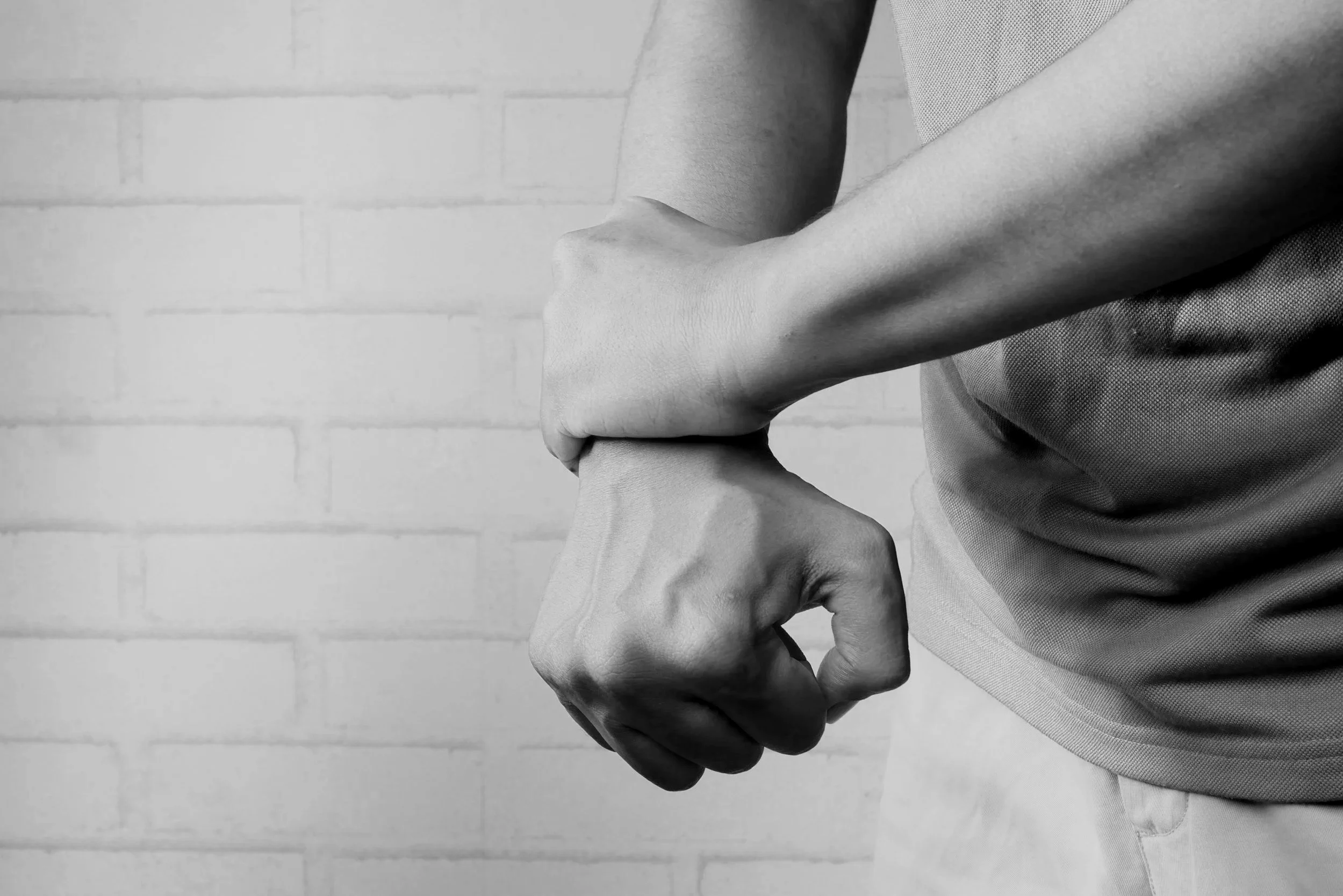
CONDITIONS TREATEDAcupuncture for Elbow, Wrist & Joint Pain
ALSO TREATED:
Headaches & Migraine · Skin Conditions · Burnout & Fatigue · Anxiety · Pain & Injuries · Back Pain · Hay Fever
Repetitive strain, overuse injuries, and chronic joint inflammation are among the most persistent complaints in clinical practice. Tennis elbow, golfer's elbow, wrist pain from prolonged computer use, and arthritic joint changes share a common thread: local tissue that has lost its capacity to recover at the same rate it is being loaded. Rest alone rarely resolves them. Neither does pushing through.
These complaints are treated as expressions of both local tissue dysfunction and broader systemic patterns, particularly where arthritis or chronic inflammation is involved.
How acupuncture helps with joint pain
Tendons and periosteal tissue have a relatively poor blood supply compared to muscle. This is part of why overuse injuries are slow to heal and quick to become chronic. When load exceeds the tissue's capacity to repair, the cycle of microtrauma and incomplete recovery compounds over time, producing the persistent pain and sensitivity characteristic of conditions like tennis elbow and wrist tendinopathy.
For elbow and wrist complaints driven by overuse or strain, treatment focuses on reducing local inflammation, improving circulation to the tendons and surrounding tissue, and releasing the muscular holding patterns that maintain strain on the affected area. The nervous system dimension is also relevant: chronic pain changes how the brain processes input from the affected region, lowering pain thresholds and producing sensitivity that outlasts the original injury. Acupuncture addresses this central sensitisation component alongside the local tissue work.
Arthritis and Bi syndrome
Arthritis warrants a more detailed explanation, both medically and in TCM terms.
From a biomedical perspective, arthritis describes a group of conditions involving joint inflammation and degeneration. Osteoarthritis involves the gradual breakdown of cartilage, leading to bone-on-bone friction, pain, and reduced range of motion. Rheumatoid arthritis is an autoimmune condition in which the immune system attacks the synovial lining of the joints, producing heat, swelling, stiffness, and progressive structural damage. Both are chronic, both involve inflammatory mechanisms, and both are significantly influenced by systemic factors including hormonal balance, metabolic health, sleep, and stress.
In TCM, joint pain with stiffness, swelling, and restricted movement falls under the category of Bi syndrome — a pattern in which the flow of Qi and Blood through the channels is obstructed by pathogenic factors. The classical pathogenic factors are Wind, Cold, and Damp, and the character of the pain reflects which predominates. Wind Bi presents as pain that moves between joints, shifting location unpredictably. Cold Bi produces fixed, intense pain that worsens markedly in cold conditions and improves with heat. Damp Bi manifests as heavy, swollen joints with persistent stiffness and a sensation of being waterlogged. Heat — either constitutional or arising from chronic obstruction transforming into fire — produces the hot, red, acutely inflamed quality characteristic of rheumatoid and inflammatory arthritis.
These patterns are not mutually exclusive. Most chronic joint presentations involve a combination, and treatment is directed at the dominant factor while addressing the underlying deficiency that allowed obstruction to take hold.
Treatment in TCM terms involves expelling the pathogenic factor, restoring the free movement of Qi and Blood through the affected channels, and strengthening the constitutional foundation. This typically means addressing Kidney and Liver function. The Kidney governs bone and is the root of constitutional vitality — its decline with age is directly reflected in degenerative joint changes. The Liver governs tendons and ligaments and ensures the smooth flow of Qi and Blood through the body. Where either is deficient or obstructed, the joints suffer. Supporting these organ systems is not adjunctive to treating the joint: it is central to it.
From a biomedical perspective, acupuncture modulates local and systemic inflammation, stimulates collagen synthesis and tissue repair, and regulates pain pathways centrally and peripherally. The two frameworks are used together in treatment planning, each informing what the other makes visible.
Arthritis cannot be reversed. What acupuncture can do is reduce pain, improve joint function, support tissue repair where it remains possible, and address the systemic factors — hormonal, circulatory, and inflammatory — that determine how the condition behaves over time.
Balance Method acupuncture for elbow, wrist and joint pain
In Balance Method acupuncture, joint complaints are approached through precise channel analysis of the affected area. The location of the pain determines which channels are involved, and treatment is delivered through their corresponding balancing meridians — typically on the opposite limb or a distal area that mirrors the affected joint through the channel imaging systems.
The elbow and wrist sit across several channel territories. The lateral elbow — the site of tennis elbow — falls primarily within the Large Intestine and Triple Warmer channels. The medial elbow — golfer's elbow — involves the Heart and Small Intestine channels. Wrist pain is mapped according to its precise location: dorsal wrist pain involves the Yang channels of the arm; palmar or medial wrist pain involves the Yin channels. Where multiple surfaces are affected, multiple channel correspondences are incorporated into treatment.
For arthritic presentations involving several joints simultaneously, the channel analysis broadens. The Bi syndrome pattern — Wind, Cold, Damp, or Heat obstruction — is identified and the channels most affected by that pathogenic factor are prioritised. The constitutional pattern — Kidney and Liver deficiency underlying the joint deterioration — is addressed alongside the local channel work.
Treatment is frequently applied to the opposite limb, using the mirroring principle: an elbow treated through the knee, a wrist through the ankle. This distal approach is often more effective than local needling in inflamed or hypersensitive joints, and allows movement assessment during the session itself.
Joint pain and related complaints
Chronic joint complaints consistently intersect with fatigue, hormonal changes, and disrupted sleep — and these connections are rarely coincidental. In older patients, arthritic patterns are frequently accompanied by Kidney deficiency in TCM terms: reduced vitality, cold sensitivity, nocturia, and declining bone and joint resilience. Treating the joint without addressing this broader pattern produces limited and short-lived results.
Where structural damage is severe, rapidly progressing, or involves suspected autoimmune activity, rheumatological assessment runs alongside acupuncture rather than being deferred for it. The two approaches are compatible and complementary, and the best outcomes tend to come from using both.
Frequently asked questions
Can acupuncture help with tennis elbow that has not responded to physiotherapy? Yes. Tennis elbow that persists despite rest and physiotherapy often involves central sensitisation alongside the local tendon pathology. Acupuncture addresses both — the local tissue environment and the nervous system component — which is why it can produce results where other approaches have not.
Is acupuncture effective for arthritis if the joint has already deteriorated structurally? Yes, within limits. Structural degeneration cannot be reversed, but acupuncture can meaningfully reduce pain, improve circulation to the affected joint, and address the systemic inflammatory and constitutional factors that influence how the condition behaves over time.
How is the mirroring principle used in treatment? In Balance Method acupuncture, the joints of the body correspond to each other across the limbs — the elbow mirrors the knee, the wrist mirrors the ankle. Needling the corresponding joint on the opposite limb through the relevant balancing channel produces a measurable effect at the site of pain, often within the session itself.
Can acupuncture help with rheumatoid arthritis alongside medication? Yes. Acupuncture is compatible with rheumatological medication and does not interfere with it. It addresses the inflammatory and constitutional pattern alongside medical management, rather than replacing it. Any changes to medication are always discussed with the prescribing doctor.
Do I need a referral from my GP? No. Acupuncture can be booked directly in the Netherlands without a referral. Costs may be partially reimbursed through supplementary health insurance (aanvullende verzekering).
Need more information or want to make an appointment?
Book online for a session in the clinic in Amsterdam Centre. If you have questions about acupuncture or how acupuncture can help you, get in touch via email.